

AgriGuide Newsletter #13 – February 2026
From the Project Chair: A Warm Welcome to 2026
As we step into 2026, I do so with genuine energy and optimism for what lies ahead. AgriGuide has continued to mature thanks to your commitment, your engagement, and your willingness to actively shape this initiative together
In the months ahead, our focus will be on preparing the digital platform for its first meaningful steps in the field. This includes onboarding additional companies, supporting countries throughout their label digitisation journey, and laying the foundations for a soft launch. Each of these milestones brings us closer to delivering a practical, reliable tool that supports farmers and stakeholders in using products safely and with confidence.
What inspires me most are the people behind this project. Across countries and workstreams, expertise is shared generously, questions are asked thoughtfully, and support is offered where it matters most. This collective mindset is what allows AgriGuide to progress with clarity, credibility, and purpose.
Thank you for everything you have contributed so far, and for the continued trust and support you bring to this journey. I look forward to the progress we will achieve together throughout 2026 and to seeing AgriGuide take its next important steps forward.
With warm regards,
Georgiana

AgriGuide Showcased at AgGateway Europe
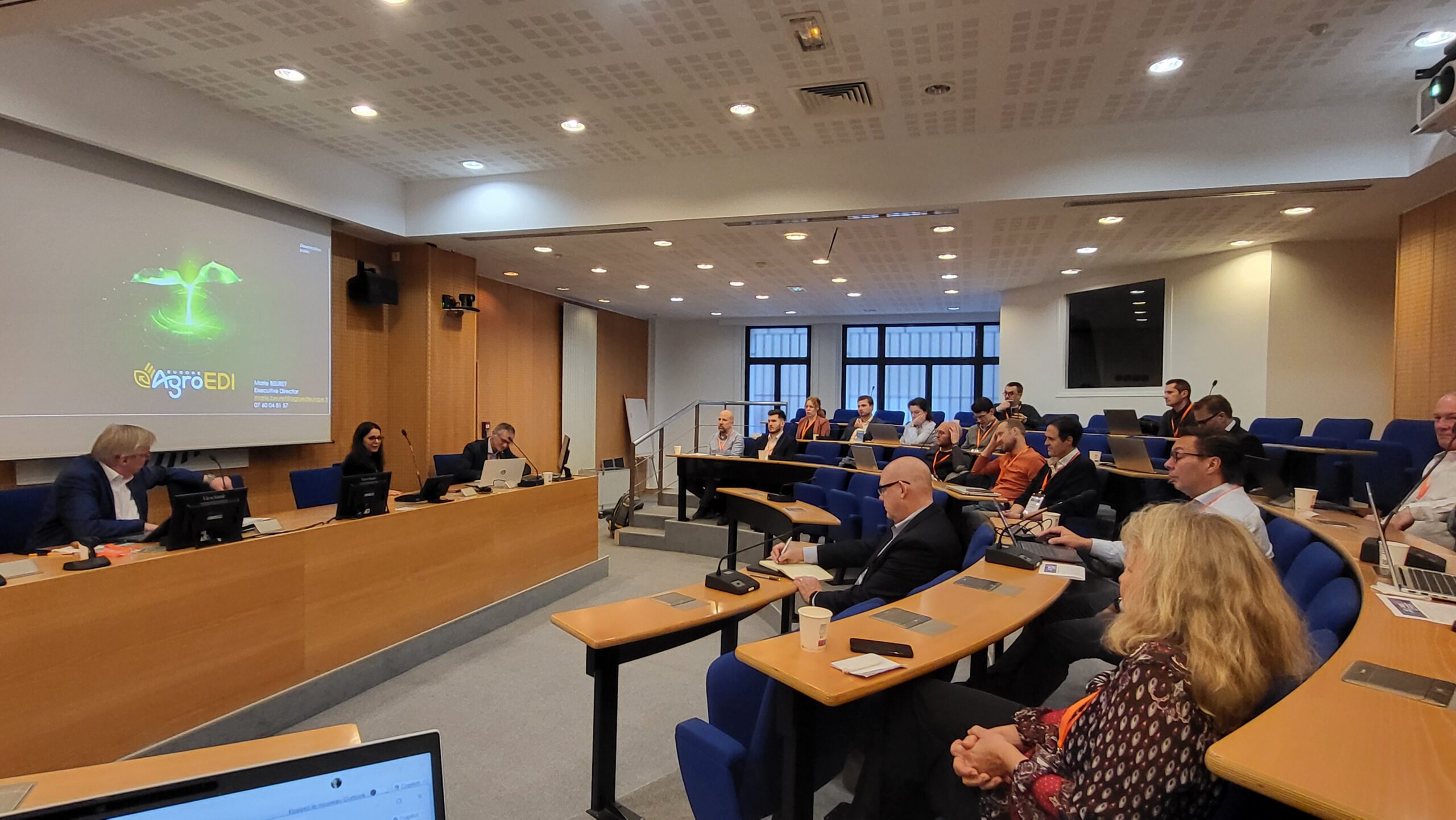
On 11 December, AgriGuide and SAppR were presented at AgGateway Europe’s yearend seminar in France. The session gathered about 40 participants from farming organisations, distributors, agtech companies, FMIS providers, data hubs and AgroEDIEurope, with the discussion focused entirely on interoperability and improving data exchange between systems.

Both presentations were well received and prompted practical questions on ensuring reliable farm data flows. Participants highlighted that interoperability depends not only on technical solutions but also on shared practices and basic governance. Feedback on AgriGuide and SAppR was positive, and collective work is already progressing, supported by international initiatives such as ISO TC 347.
Data quality emerged as a key theme. AgriGuide was noted as an example of wellstructured guidance data, which raised interest in extending similar approaches to seeds, fertilisers and other inputs (“AgriGuide”).
Digital Partnership Advances at Recent Industry Event
AgriGuide participated in a successful industry gathering on the 16th of December 2025 that brought together key stakeholders from across the agricultural technology sector. The event, which included representatives from the European Commission, facilitated important discussions on digital innovation in agriculture.
Representatives from CEMA and COPA-COGECA joined CLE member companies in showcasing current digital solutions and exploring opportunities for greater collaboration. The session enabled productive dialogue on critical priorities, including regulatory simplification and system interoperability, reflecting AgriGuide’s commitment to working with the broader agricultural ecosystem to deliver practical solutions that benefit farmers whilst supporting regulatory compliance.
Regulatory Update
The new labelling regulation
The Member States have voted in favour of the Commission’s draft labelling regulation intended to replace the current Regulation 547/2011. The proposed new regulation aims to make it easier for users of pesticides to understand the content of PPP labels with regard to safety and use instructions. The new labels provide more clearly standardised information on the safe handling and conditions of use of pesticides, the disposal of empty containers, indications of specific hazards or risks (for example, to bees), as well as the risk‑mitigation and precautionary measures that users must take to protect human health and the environment. In addition to physical labelling, the proposed new regulation introduces a digital label, facilitating easier access to information for users.
Once translated, the draft Regulation will undergo a three‑month scrutiny period by the Council and the Parliament. After final adoption, the new labelling requirements will apply to all new or renewed plant protection product applications submitted after 1 January 2028.
AgriGuide Country Roll-Out
The EU countries continue to expand the number of labels published on the AgriGuide platform. In addition to the three pilot countries, Spain, Ireland, France and Lithuania have now reached a level of robustness that enables member companies to digitalise their full portfolios and to welcome new participants.
In this context, AEPLA (the Spanish industry association) organised a successful event to pre-onboard companies interested in joining AgriGuide. A total of 23 companies took part in this event.
Progress continues across the remaining countries, and several more will soon be able to digitalise the complete portfolios of participating companies.
From the Technical Corner
January, and a new year begins. We started 2026 with a virtual workshop for the core tech team, first taking stock of the progress the whole project made in 2025, with labels digitised, countries onboarded, and features added to the platform. And then reviewed the targets we have for the coming months. Country support brings new and revised translations for reference data and app headings; there are small but important extensions to the label data model to introduce, and there are preparations to enable the native Android and iOS apps in the country app stores. We also reviewed the recent updates to regulations and updated our roadmap to align with those.
A major feature that is being extensively tested is simple application records, finalising this stripped back, just the basics approach for testing in pilot countries by a wider group. This will make use of the set of product catalogues that were delivered in December. These catalogues are mostly derived from country databases, but where those are unavailable, they make use of product lists directly from companies. These make it easy for a farmer to look up the specific product they have used and combine that with the location, quantity and date of application to create a digital record of use. The farmer is able to create a series of records over time and download those for their own purposes or to share with an official body, when required.
Finally, the team is planning for the next series of internal technical webinars to build on the well-received 2025 webinars, and for a series of technical engagements with standards bodies and with potential integration partners.
Meet the Team!
Hello from Linnea
Here are the five questions we asked Linnea to get to know her a little better!

Before we get into AgriGuide, could you briefly introduce yourself?
My name is Linnéa Philine Koll, and I live in the northern part of Germany, in the area of Bremen, together with my husband, our daughter and our two dogs. I originally come from this region, but we lived in Berlin for several years, where I also met my husband. With a background in nutritional science, I joined BASF Regulatory Affairs Crop Protection five years ago, which eventually led me to AgriGuide.
Could you tell us a little more about your role within AgriGuide, what are your main responsibilities and day to day focus?
Within AgriGuide, I have two roles. I coordinate BASF’s rollout to all EU Member States, aligning with country colleagues and turning regulatory requirements into practical digital label workflows. In this role, I stay in close contact and communication with teams in the countries to keep feedback loops short and to make sure their specific needs and inputs are reflected. In this project, it is crucial to understand the individual country needs and requirements, to support the colleagues working on the implementation in the countries, and to hear the voices of the farmers. On the other hand, I also contribute to the AgriGuide transformation workstream, where we frame the project internally and make sure our way of working stays aligned with industry discussions and the evolving regulatory framework.
You joined AgriGuide in April 2025 as the newest member of the core project team. How did you get up to speed, and who or what supported you during onboarding?
When I joined in March 2025, I combined deep dive learning with direct engagement. I reviewed all existing AgriGuide materials, such as the playbook and previous documentation. At the same time, I set up regular touchpoints with our BASF AgriGuide sub-team member, Krisztian Szegedi, who helped me understand the strategic context and ongoing discussions. I also reached out to colleagues with key roles, such as Gaëlle and Raj, to learn about their perspectives, challenges, and the current status, as AgriGuide is a complex and fast-moving project. These one-on-one exchanges helped me connect the dots quickly. Hands-on work with the country pipeline, especially the label digitisation waves, eventually gave me the practical insights needed to understand how everything works together. It felt a bit like learning a language where things truly click once you start applying them.
Away from the office, do you have any hobbies or passions that most people might not know about?
My two dogs are already a hobby on their own. One is an English Cocker Spaniel, and the other is a Cocker mix, and I love taking them for runs in nature. Spending time outdoors with my husband and daughter is one of the best ways for me to unwind, but we also enjoy board games together. Another passion of mine is caring for indoor plants, and I now have around seventy to eighty of them. In general, being surrounded by nature helps me disconnect and recharge.
Looking ahead, what difference do you hope to make on the AgriGuide project?
I hope to contribute by keeping AgriGuide both regulatory-sound and practical for the real users who rely on it. This means strengthening the quality and consistency of our label data, making internal and country alignment smoother and staying closely connected to ongoing CLE discussions. Communication is essential because many different needs and visions come together in this project. I want to support a transparent and collaborative way of working so that everyone involved feels supported, heard and part of the journey. Ultimately, I hope my contribution helps make AgriGuide a tool that is easy to use, reliable and genuinely helpful.
Learnings from Romania on label digitisation

Romania has now fully digitised its entire portfolio, marking an important milestone. What helped them succeed, what challenged them most, and what tips they would share with others all came through clearly in their story. We spoke to Carmen Botez and Ionuț Dumitru from AIPROM (Asociatia Industriei de Protectia Plantelor din Romania – Romanian Crop Protection Association) to find out more
What helped you throughout the digitisation process/how did you manage this?
In general, we relied on a blend of strategic planning, specialised tools, and a focus on human factors such as skill-building. None of the Romanian country team members are IT experts, so the first step was to develop the necessary skills.
From a technology perspective, we started with a small, manageable pilot project, tested different options, and validated workflows. However, the thing that helped us the most was realising, perhaps not early enough, that we first needed to harmonise our views and act as a team rather than as individuals.
What was the most challenging aspect, and how did you mitigate it?
I would say that there were too many streams of action in the first phase, and we, the pilot countries, had to understand what each one expected from us and what support they could offer. We began communicating much more intensively within the team and organised a schedule of regular meetings to update one another and create a jointly agreed list of issues we could not clarify or resolve ourselves. The introduction of the ticket system also helped improve the situation.
Stakeholder engagement was another challenge. The reality of becoming immersed in the project work was quite different from our expectations, which had been shaped by initial conversations with the AgriGuide team. By taking one small step after another, we came to understand that this project is about learning by doing, at least during the first few months.
Any tips or suggestions that you would like to share with others?
Involving internal regulatory colleagues from the very beginning helps ensure buy-in and makes use of their deep knowledge of daily operations. This is expertise that external specialists may not have. It is also very important to ensure that the member who chairs the country team is a clear-minded specialist, a strong coordinator, and an ambitious person. This individual will need to represent the entire team and present all matters that must be addressed by the technical team.
What’s Next
Overview of key events in February and March :
- 11 February 2026 — Webinar with Member States
- 3–4 March 2026 — Annual CLE Conference
- 5 March 2026 — Q1 ST F2F, Brussels
- 10–12 March 2026 — France Distributors Event
- 11 March 2026 — ISO Plenary
- 11 March 2026 — AgriGuide Community Event